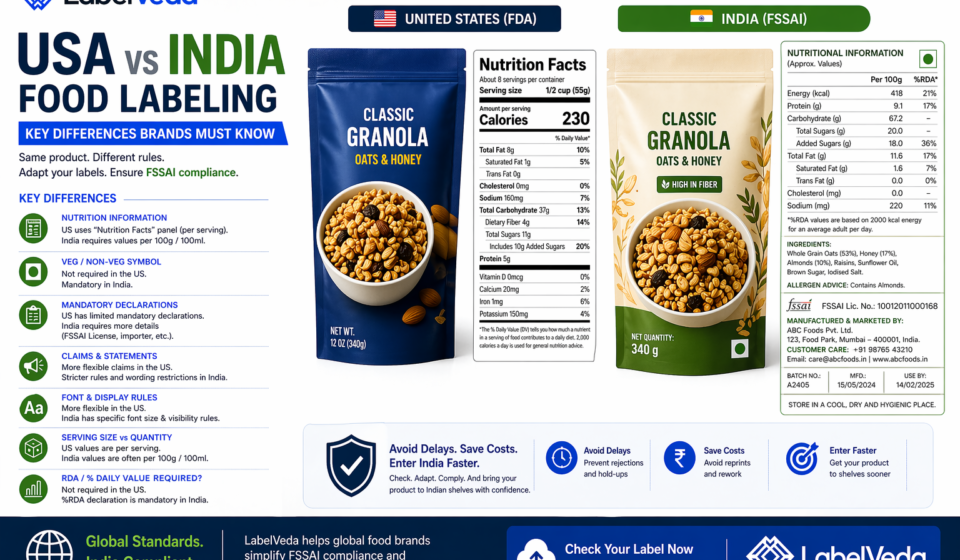
USA vs India Food Labeling: Key Differences Brands Must Know

If you’re a global food brand entering India, your existing label might not work as-is.
Even if your product complies with US standards, it can still fail in India.
👉 Why? Because food labeling rules differ significantly.
Understanding these differences early can save:
- Time
- Cost
- Multiple redesign cycles
Who Regulates Food Labels?
In the US, labeling is governed by
Food and Drug Administration
In India, it is regulated by
Food Safety and Standards Authority of India
👉 Both have strict rules—but they are not identical
Key Differences at a Glance
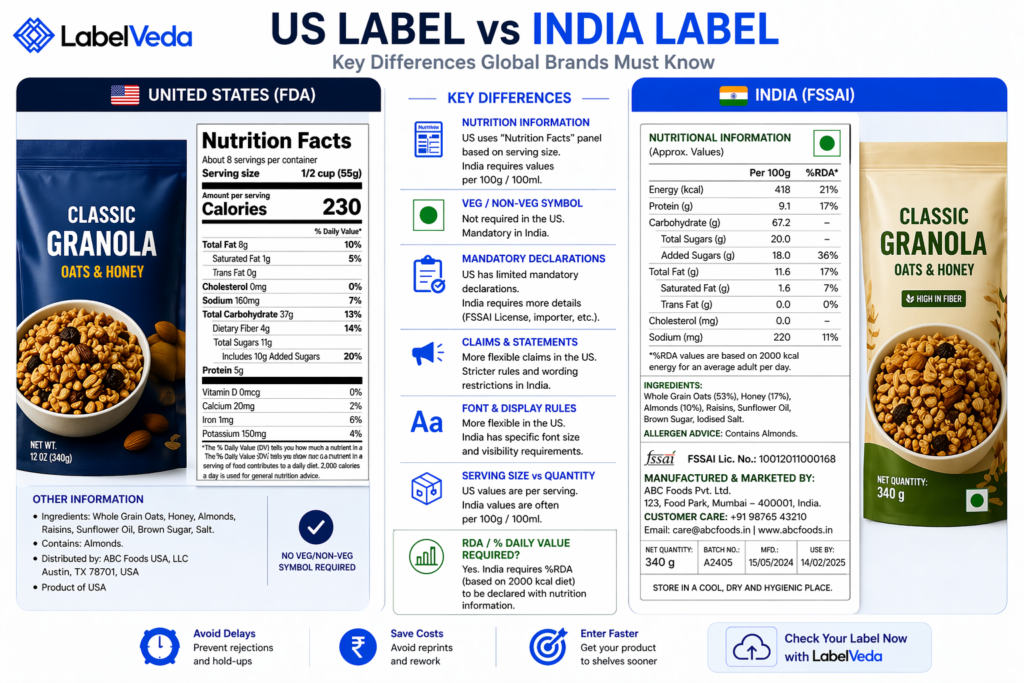
| Aspect | USA | India |
|---|---|---|
| Nutrition Format | Standard “Nutrition Facts” panel | Specific FSSAI format |
| Vegetarian Symbol | Not required | Mandatory |
| Serving Size | Defined per serving | Often per 100g / 100ml |
| Claims Regulation | Strict but flexible wording | Highly controlled wording |
| Mandatory Declarations | Limited | More detailed requirements |
| Font & Display Rules | Flexible | More prescriptive |
👉 These differences seem small—but they matter
1. Nutrition Label Format
US labels use the familiar Nutrition Facts panel.
India requires:
- A different format
- Often values per 100g / 100ml
- Additional structuring rules
👉 Directly copying US format = non-compliance
2. Vegetarian / Non-Vegetarian Symbol
In India, this is mandatory.
- 🟢 Green dot → Vegetarian
- 🔴 Brown/red dot → Non-vegetarian
👉 Missing this alone can lead to rejection
3. Mandatory Declarations
India requires more detailed declarations, including:
- FSSAI license number
- Manufacturer/importer details
- Net quantity formatting
- Batch & date information
👉 These are not always present in US labels
4. Health & Marketing Claims
Both countries regulate claims—but differently.
India:
- More restrictive
- Requires careful wording
US:
- Allows more flexibility (within limits)
👉 Claims acceptable in the US may not be allowed in India
5. Font Size & Readability
India has clearer rules around:
- Minimum font sizes
- Visibility
- Placement
👉 Design layout often needs adjustment
The Real Cost of Ignoring These Differences
Many brands assume:
👉 “We’ll just tweak the label later”
But this leads to:
- Rejection during import or listing
- Delays in launch
- Reprinting costs
- Loss of momentum
A Smarter Way to Adapt Labels
Instead of reacting after rejection:
👉 Review your label before submission
A structured check helps you:
- Identify gaps early
- Align with Indian requirements
- Reduce rework
🧪 Quick Self-Check for Global Brands
Before entering India, ask:
- Is your nutrition panel aligned with Indian format?
- Have you added the veg/non-veg symbol?
- Are all mandatory declarations included?
- Are your claims compliant?
👉 If not, your label needs adaptation
Why This Matters for Market Entry
Speed matters.
Brands that:
- Adapt early
- Submit correctly
- Avoid rework
👉 Get to market faster
👉 Before You Adapt Your Label for India
Take a few minutes to review your current packaging.
It can:
- Prevent delays
- Reduce costs
- Improve approval chances
👉 You can run a quick compliance check using LabelVeda to identify gaps before adapting your label.