Nutraceutical & Health Supplement Labeling in India: What FSSAI Actually Requires

The nutraceutical and health supplement market in India is growing fast—driven by products like protein powders, immunity boosters, and dietary supplements.
But this growth comes with a catch:
👉 This is one of the most tightly regulated segments under FSSAI
And most compliance failures happen at one place:
👉 The product label
Regulatory Framework You Need to Know
Nutraceutical and health supplement labeling in India is governed by:
- Food Safety and Standards Authority of India
- FSSAI (Health Supplements, Nutraceuticals, Food for Special Dietary Use, Food for Special Medical Purpose) Regulations, 2016
- FSSAI Labelling and Display Regulations, 2020
👉 These define what you can say, how you present it, and what must be declared.
What Qualifies as a Nutraceutical or Health Supplement?
Under FSSAI, this category includes:
- Health supplements
- Nutraceuticals
- Protein supplements and sports nutrition
- Dietary supplements
- Functional foods
These products are regulated differently from conventional foods because:
👉 They often make health or functional claims
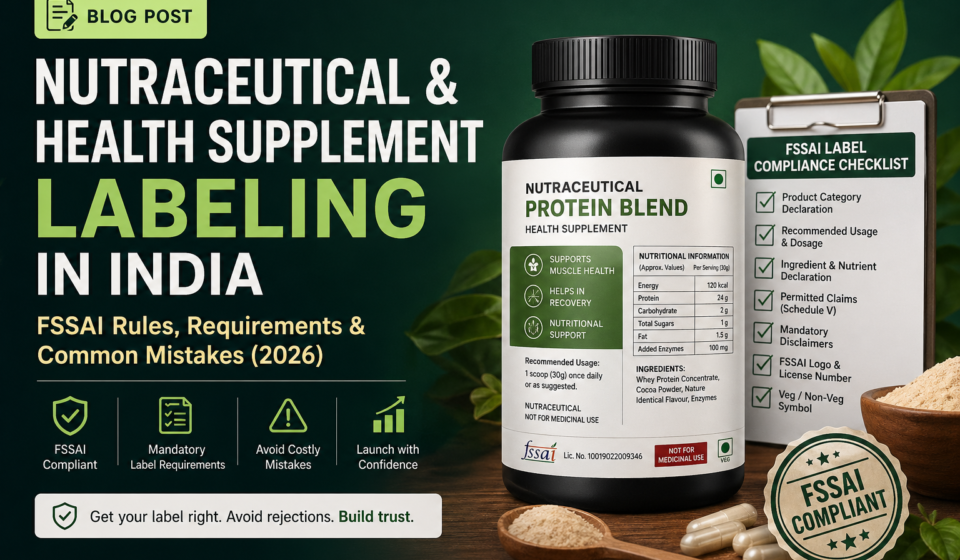
Mandatory Label Requirements (As per FSSAI)
A compliant nutraceutical or supplement label must include:
1. Product Category Declaration
The label must clearly state:
- “Health Supplement”
- “Nutraceutical”
👉 This is not optional—it defines how your product is regulated.
2. Recommended Usage & Dosage
As per 2016 regulations:
- Recommended daily usage must be mentioned
- Directions for use must be clearly stated
👉 Missing dosage instructions is a common compliance failure
3. Mandatory Disclaimer
Most nutraceuticals require:
“This product is not intended to diagnose, treat, cure or prevent any disease”
👉 Incorrect or missing disclaimers can trigger rejection
4. Ingredient & Nutrient Declaration
You must declare:
- All ingredients
- Active ingredients with quantities
- Units (mg, IU, etc.)
- Per serving values
👉 This must follow prescribed format under labeling regulations
5. FSSAI License Number & Logo
As per labeling rules:
- FSSAI logo must be displayed
- License number must be clearly mentioned
👉 Missing this = immediate non-compliance
6. Veg / Non-Veg Symbol
Mandatory for all food products in India.
Health Claims: The Highest Risk Area
Claims are governed under Schedule V of FSSAI Nutraceutical Regulations
This means:
- Only specific types of claims are allowed
- Claims must be scientifically supported
- Wording must not be misleading
Examples of risky claims:
- “Boosts immunity instantly”
- “Builds muscle rapidly”
- “Prevents disease”
👉 These can easily violate FSSAI guidelines
Special Focus: Protein Supplements
Protein powders and sports nutrition products face stricter scrutiny because:
- Claims are performance-driven
- Consumers rely heavily on label information
Key requirements:
- Accurate protein content declaration
- Clear serving size
- Proper usage instructions
👉 Misrepresentation here can lead to rejection or penalties
Common Mistakes That Lead to Rejection
Based on real-world patterns, most brands fail due to:
- Missing mandatory declarations
- Incorrect or exaggerated claims
- Incomplete ingredient disclosure
- Improper nutrition format
- Missing dosage instructions
👉 These are avoidable—but often caught too late
The Cost of Getting It Wrong
Non-compliant labels can result in:
- Marketplace rejection (Amazon, retail chains)
- Delays in product launch
- Reprinting costs
- Regulatory scrutiny
👉 Fixing a label after printing is significantly more expensive than getting it right upfront
Why Even Experienced Teams Struggle
- Regulations are detailed and evolving
- Interpretation is not always straightforward
- Designers are not compliance experts
👉 This creates gaps between design and regulation
A Practical Approach to Compliance
Instead of reacting after rejection:
👉 Validate your label before printing
This ensures:
- All mandatory elements are present
- Claims are within limits
- Structure follows FSSAI expectations
Where LabelVeda Fits In
LabelVeda helps nutraceutical and supplement brands:
- Review labels against FSSAI requirements
- Identify missing or incorrect elements
- Flag potential compliance risks
- Prepare labels before submission or printing
👉 So you don’t discover issues after launch
Quick Compliance Checklist
Before finalizing your label, check:
- Is product category clearly defined?
- Are dosage and usage instructions included?
- Are claims compliant with FSSAI guidelines?
- Are all mandatory declarations present?
- Is nutritional information correctly structured?
👉 If you’re unsure about any of these, your label needs review
Final Thought
In nutraceuticals, compliance is not a formality.
👉 It directly affects your ability to launch, sell, and scale.
Getting your label right the first time is not just safer—it’s faster and more cost-effective.
👉 Before You Print Your Label
Take a few minutes to validate your label.
👉 Use LabelVeda to check for compliance gaps before going to market.