How Global Brands Can Adapt Their Food Labels for India (FSSAI Compliance Guide)

Expanding into India is a major opportunity for global food and beverage brands.
But one of the most underestimated challenges is:
👉 Adapting your product label to meet FSSAI requirements
Many brands assume their existing labels will work.
In reality:
👉 Even well-designed international labels often fail compliance checks in India.
Why Global Labels Don’t Automatically Work in India
Each country has its own regulatory framework.
In India, food labeling is governed by
Food Safety and Standards Authority of India
Which has specific requirements for:
- Nutritional format
- Ingredient declaration
- Symbols and markings
- Mandatory statements
👉 Missing or incorrect elements can delay market entry
Common Issues Global Brands Face
When adapting labels for India, typical gaps include:
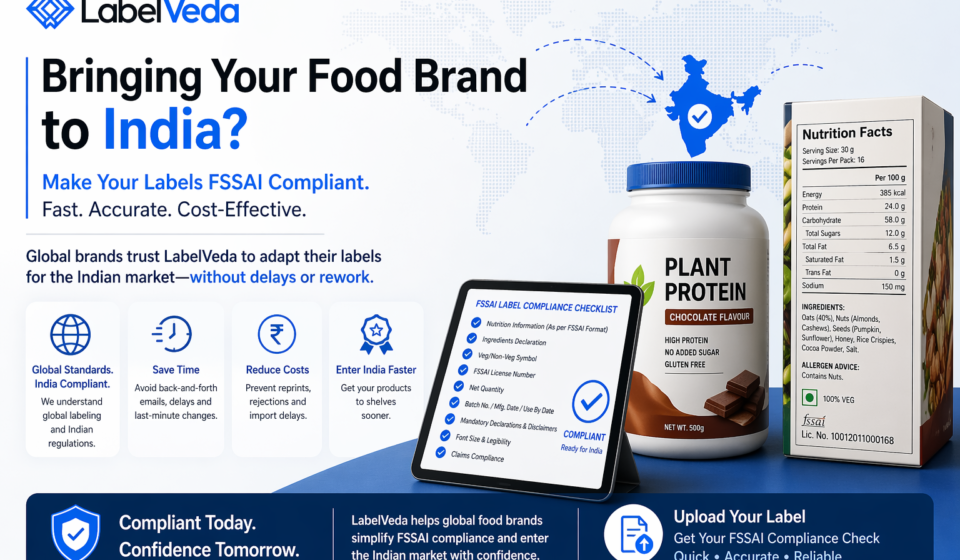
- Incorrect nutritional format (not aligned to Indian standards)
- Missing vegetarian/non-vegetarian symbol
- Incomplete ingredient declaration
- Incorrect font sizes or placement
- Missing mandatory declarations
👉 These are small differences—but critical for compliance
The Real Cost of Getting It Wrong
Non-compliant labels don’t just create minor delays.
They can lead to:
- Rejection during product registration
- Delays in import clearance
- Reprinting and redesign costs
- Missed market opportunities
👉 Market entry slows down significantly
Why Traditional Approaches Don’t Scale
Many global brands rely on:
- Local consultants
- Back-and-forth revisions
- Manual compliance checks
This often leads to:
- Longer timelines
- Higher costs
- Lack of clarity
A Faster Way to Adapt Labels for India
Instead of multiple iterations:
👉 Start with a structured compliance check
This helps you:
- Identify gaps instantly
- Understand required changes
- Reduce dependency on repeated reviews
What You Should Check First
Before adapting your label, verify:
- Is the nutrition panel in the correct format?
- Are all mandatory declarations included?
- Are symbols and markings compliant?
- Is the ingredient list correctly structured?
👉 These are the most common friction points
Practical Approach for Global Teams
A simple workflow:
- Take your existing label
- Review it against Indian requirements
- Identify gaps
- Update before submission
👉 This reduces rework significantly
Why This Matters for Market Entry
When entering a new market:
👉 Speed matters
Brands that:
- Adapt faster
- Submit correctly
- Avoid rework
👉 Get to shelves faster
Where a Structured Tool Helps
Instead of relying only on manual reviews:
👉 A structured compliance check can act as a first filter
Helping you:
- Catch issues early
- Reduce delays
- Improve submission quality
👉 Before You Submit Your Label for India
Take a few minutes to review your label carefully.
It can:
- Save weeks of back-and-forth
- Reduce compliance risk
- Speed up your market entry
👉 You can run a quick compliance check using LabelVeda to identify gaps before adapting your label.