FSSAI Advisory 2026: Ashwagandha Leaves Banned in Food Products – Complete Compliance Guide

Introduction
In April 2026, the Food Safety and Standards Authority of India (FSSAI) issued a critical regulatory advisory that directly impacts manufacturers of nutraceuticals, health supplements, and functional foods.
The advisory clarifies a long-standing ambiguity:
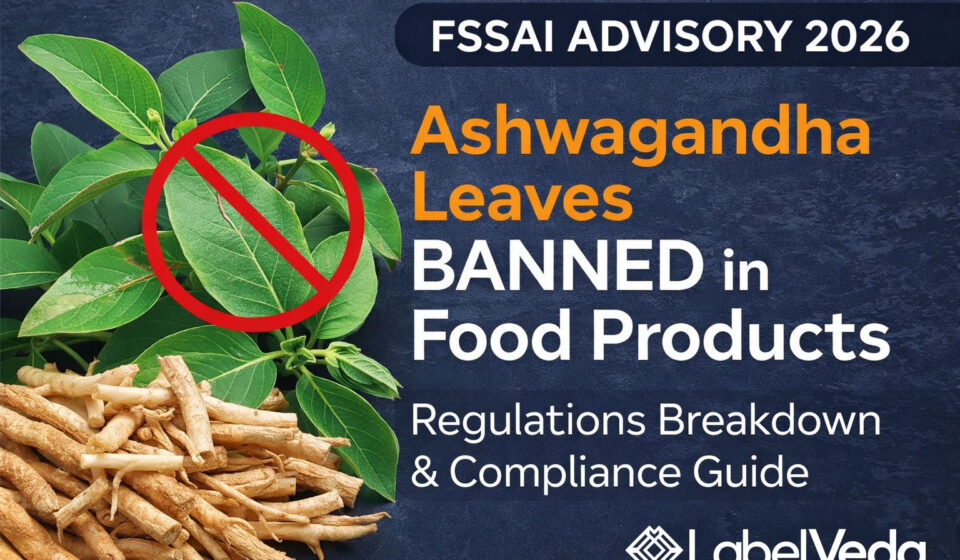
Ashwagandha leaves are NOT permitted in food products in India.
While many brands have been using different parts of the Ashwagandha plant, this update makes it clear that only specific parts are legally allowed.
If you’re a food business operator (FBO), ignoring this update could lead to regulatory action, product recalls, or penalties.
This guide breaks down everything you need to know — in plain English.
What Is the FSSAI Advisory About?
The FSSAI advisory (dated April 16, 2026) addresses the use of Ashwagandha (Withania somnifera) in food products.
Key clarification:
- Only Ashwagandha roots and their extracts are permitted
- Leaves are strictly not allowed in any form:
- Crude
- Powder
- Extract
- Any derivative
This applies across:
- Health supplements
- Nutraceuticals
- Functional foods
- Foods for special dietary use
The advisory was issued after it was observed that several manufacturers were still using Ashwagandha leaves, despite existing regulations.
Is This Advisory Mandatory or Optional?
Let’s address the confusion directly.
Short answer: It is mandatory in practice.
Even though the document is titled an “advisory,” it clearly states:
- The use of Ashwagandha leaves is not permitted under current regulations
- Non-compliance will attract action under the Food Safety and Standards Act, 2006
Additionally:
- State authorities have been instructed to monitor and enforce compliance
- Licensing authorities are expected to take action against violations
That means this is not a suggestion — it’s enforceable.
Why Are Ashwagandha Leaves Banned?
This isn’t arbitrary. There’s a strong scientific and regulatory basis behind it.
1. Safety Concerns
Studies have shown that Ashwagandha leaves may contain:
- Higher concentrations of Withaferin-A
- Other reactive withanolides
These compounds may pose potential health risks when consumed in certain forms or quantities.
2. AYUSH Recommendation
The Ministry of AYUSH has clearly directed:
- Use only Ashwagandha roots
- Leaves are strictly prohibited
This is based on:
- Traditional usage systems (Ayurveda)
- Updated safety dossiers (2024 review)
3. Regulatory Alignment
FSSAI regulations (Schedule IV) already specify:
- Permitted plant parts for use in food products
The advisory simply:
✔ Reinforces existing law
✔ Closes misuse gaps
✔ Aligns food and AYUSH regulations
What Does the Law Actually Allow?
✅ Allowed:
- Ashwagandha roots
- Root extracts
❌ Not Allowed:
- Leaves
- Leaf extracts
- Whole plant (if leaves included)
- Any formulation containing leaf derivatives
Who Is Affected by This Regulation?
This advisory impacts a wide range of businesses:
1. Nutraceutical Brands
- Capsules
- Tablets
- Herbal blends
2. Functional Food Companies
- Health drinks
- Protein mixes
- Wellness powders
3. D2C Wellness Startups
- Adaptogen blends
- Stress-relief products
4. Contract Manufacturers
- Private label supplement manufacturers
What Happens If You Ignore This?
Let’s be very clear — this is where most brands underestimate the risk.
Possible consequences:
- Product rejection during approval
- Mandatory product reformulation
- Product recalls from market
- Financial penalties
- License suspension or cancellation
And more importantly:
Loss of trust with distributors and marketplaces (Amazon, Flipkart, etc.)
How to Ensure Compliance (Step-by-Step)
Here’s a practical checklist you can follow immediately:
Step 1: Audit Your Ingredients
- Check if any product uses:
- Ashwagandha leaves
- Leaf extracts
- Mixed plant powders
Step 2: Verify Supplier Documentation
- Ask suppliers:
- Which plant part is used?
- Do they have COA (Certificate of Analysis)?
Step 3: Reformulate If Needed
If leaves are present:
- Replace with root extract
- Ensure dosage complies with FSSAI limits
Step 4: Update Labeling
- Clearly mention:
- “Ashwagandha Root Extract”
- Avoid vague terms like:
- “Ashwagandha Extract” (without specifying part)
Step 5: Maintain Documentation
Keep ready:
- Ingredient specs
- Lab reports
- Supplier declarations
Common Mistakes to Avoid
1. Using generic ingredient names
Example: “Ashwagandha Extract”
→ Not acceptable without specifying plant part
2. Assuming herbal = safe
Natural ingredients still need regulatory approval
3. Copying competitor labels
Many brands are non-compliant without realizing it
4. Ignoring advisory updates
Regulations evolve — staying updated is critical
How This Impacts Label Compliance
This advisory highlights a deeper issue:
👉 Ingredient compliance is just as important as label formatting
Even if your label looks perfect:
- Wrong ingredient = non-compliant product
This is exactly where most brands fail.
How LabelVeda Can Help
If you’re building or selling food products, manual compliance checks are risky and time-consuming.
LabelVeda helps you:
- ✅ Detect non-permitted ingredients instantly
- ✅ Validate label compliance as per FSSAI
- ✅ Avoid costly mistakes before printing
- ✅ Stay updated with latest advisories
Try it before your next product launch
Don’t wait for a rejection or penalty.
Run your label through LabelVeda and catch compliance issues in seconds.
Final Thoughts
The 2026 FSSAI advisory on Ashwagandha is a wake-up call for the industry.
It reinforces a simple rule:
Not all parts of a plant are allowed — and using the wrong one can cost you your business.
If your product contains Ashwagandha:
- Stick to roots only
- Avoid leaves completely
- Document everything
Because in food compliance:
👉 Assumptions are expensive. Accuracy is everything.