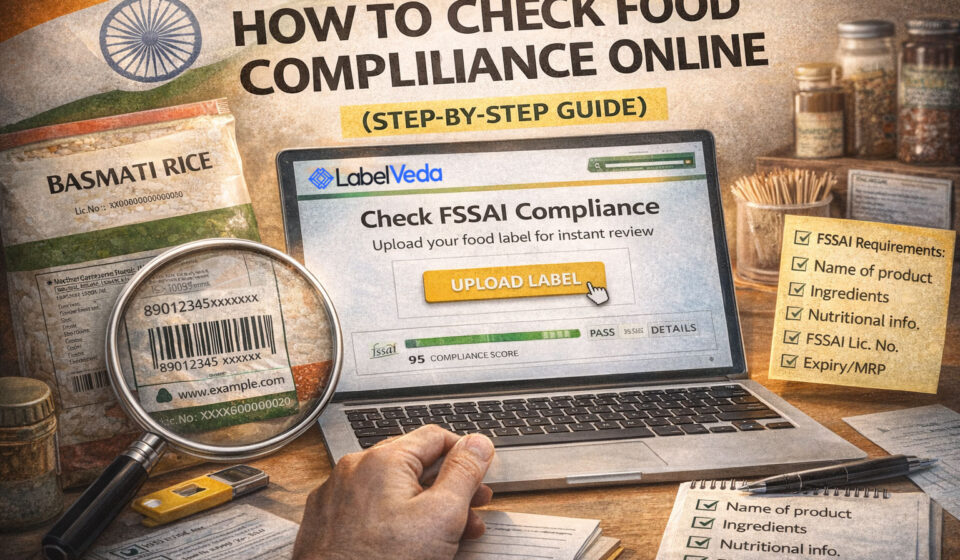
How to Check Food Label Compliance Online (Step-by-Step Guide)

Ensuring your food label complies with FSSAI regulations is not optional — it’s critical for launching and scaling any packaged food product in India.
The challenge?
Most founders, designers, and manufacturers are not 100% sure if their label is compliant until it’s too late.
This guide walks you through a step-by-step process to check food label compliance online, before you go for printing or distribution.
✅ Step 1: Gather Your Label File
Before starting, make sure you have:
- Final label design (PDF / Image)
- All sides of packaging (front, back, sides)
- Nutritional table clearly visible
👉 If your label is still in draft form, that’s even better — you can fix issues early.
✅ Step 2: Check Mandatory Elements
Start with a basic checklist. Your label must include:
- Product name
- Ingredient list (in descending order)
- Nutritional information (per 100g/ml)
- Veg / Non-veg symbol
- FSSAI license number
- Net quantity
- Manufacturer details
- Batch / Lot number
- Date of manufacture / expiry
- MRP
- Customer care details
👉 Missing even one of these can lead to non-compliance.
✅ Step 3: Verify Format & Placement Rules
This is where most labels fail.
Check:
- Font size is readable (not too small)
- Mandatory info is clearly visible
- Veg/Non-veg symbol is properly placed
- No overlapping or hidden text
- Nutritional table format is correct
- Misleading product claims
👉 Compliance is not just about what is written, but also how it is presented.
✅ Step 4: Validate Category-Specific Rules
Depending on your product, additional rules may apply:
- Sweeteners → warning statements
- Fortified foods → declaration + logo
- Infant foods → different nutrition rules
- Small packs → relaxed logo requirements
👉 This is where manual checking becomes difficult.
✅ Step 5: Cross-Check Against Latest Amendments
FSSAI regulations are updated periodically.
For example:
- Recent amendments impact non-retail packaging
- Changes in declaration formats
- Updated definitions (e.g., minimally processed foods)
👉 If you’re checking manually, this step is often missed.
⚠️ The Problem with Manual Checking
Manual validation is:
- Time-consuming
- Easy to miss details
- Difficult to scale across multiple SKUs
And most importantly:
👉 It depends heavily on your interpretation of the rules.
🚀 Step 6: Use an Online Compliance Checker
The fastest and most reliable way:
- Upload your label
- Let the system scan for compliance
- Get a structured report
This helps you:
- Identify missing elements instantly
- Detect formatting issues
- Catch risks before printing
🔍 What a Good Compliance Tool Should Do
When choosing a tool, look for:
- FSSAI-specific validation
- Coverage of latest amendments
- Detailed compliance report
- Easy upload (image/PDF)
- Clear scoring or risk indicators
🧠 Practical Tip
If you’re:
- A founder → check before printing
- A designer → validate before delivery
- A manufacturer → standardize across SKUs
👉 Compliance should be part of your workflow, not an afterthought.
✅ Check Your Label in Minutes
Instead of manually going through every rule:
Upload your label and get a structured compliance check.
- Instant compliance score
- Detailed issue breakdown
- Based on current FSSAI regulations
→ Check your label compliance now
📌 Final Thoughts
Food label compliance is not complicated — but it is precise.
And precision is where most businesses fail.
A small mistake on your label can lead to:
- Product rejection
- Reprinting costs
- Delayed launches
The smarter approach:
👉 Validate early. Fix fast. Launch confidently.