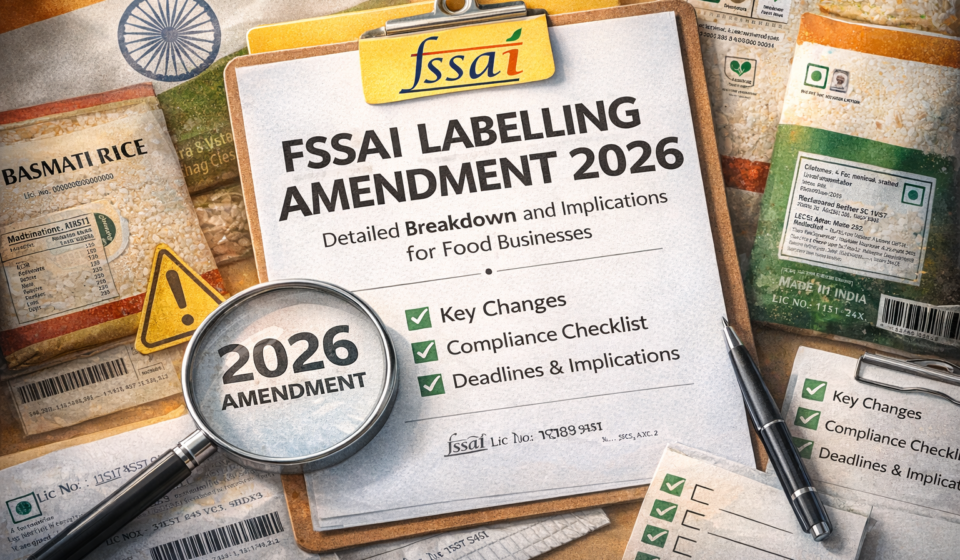
FSSAI Labelling Amendment 2026: Detailed Breakdown and Implications for Food Businesses

The Food Safety and Standards Authority of India (FSSAI) issued a notification on 24 March 2026 introducing amendments to the Food Safety and Standards (Labelling and Display) Regulations, 2020.
These changes will come into force from 1 July 2027, giving businesses a defined transition window to align their labels, packaging systems, and internal processes.
This article provides a clause-level breakdown of the amendment along with its practical implications for manufacturers, designers, and food businesses.
1. Regulatory Context
The amendment primarily impacts:
- Regulation 5 (Nutritional Information)
- Regulation 8 (Display requirements)
- Regulation 10 (Non-retail packaging)
- Schedule I & II (fortification and declarations)
The overall direction indicates a shift toward:
- Greater clarity in definitions
- Increased flexibility in B2B scenarios
- Stronger emphasis on readability and transparency
2. Changes in Nutritional Labelling (Regulation 5)
Key Update:
For infant nutrition products:
- Percentage contribution to Recommended Dietary Allowance (RDA) per serving is not mandatory
- Number of servings per pack is not required
Interpretation:
This deviation from standard requirements likely reflects:
- The complexity of infant nutrition labelling
- The need to avoid misleading serving-based interpretations
3. Definition of “Minimally Processed Foods”
The amendment introduces a clearer classification:
Includes:
- Cereals, pulses, fruits, vegetables
- Single-ingredient foods
Also clarifies that processes such as:
- Cleaning
- Grinding
- Refrigeration
- Pasteurization
- Fermentation
- Freezing
do not materially alter nutritional value.
Practical Impact:
This reduces ambiguity in classification and helps standardize compliance expectations across categories.
4. Relaxation for Small Packages (≤100 sq cm)
Key Change:
Certain FSSAI logos:
- May be omitted on packages ≤100 sq cm
- Must be present on multi-unit packaging
Impact:
Relevant for:
- Sachets
- Trial packs
- Low-cost SKUs
Design Consideration:
While space constraints are acknowledged, compliance shifts to the outer packaging layer.
5. Overhaul of Non-Retail Labelling (Regulation 10)
This is one of the most operationally significant updates.
5.1 Mandatory Information
Non-retail packages must include:
- Name of food
- FSSAI logo and license number
- Date marking (where applicable)
- Batch / Lot / Code number
- Manufacturer / packer details
5.2 Flexibility in Information Placement
Information may be provided through:
- Labels
- Attached documentation
- Electronic formats (in B2B supply chains)
5.3 Reduced Redundancy
If full information is already available on pre-packaged units inside the container:
→ Repetition on outer packaging is not required
Practical Note
Interpreting non-retail labelling requirements can become complex, particularly when information is distributed across labels, documents, and multiple packaging layers.
For businesses handling multiple SKUs or supply formats, structured validation systems can help ensure that all mandatory elements are consistently applied across scenarios.
6. Mandatory Identification of Non-Retail Containers
Non-retail packages must clearly indicate:
- “NON-RETAIL CONTAINER”
- OR “NOT FOR DIRECT SALE TO CONSUMER”
Why this matters:
This reduces the risk of:
- Accidental retail sale
- Misinterpretation at distribution levels
7. Strengthening of General Labelling Principles
The amendment reinforces that all label information must be:
- Clear
- Prominent
- Legible
- Tamper-evident
Implication:
Greater scrutiny can be expected on:
- Typography choices
- Information hierarchy
- Visibility under normal usage conditions
8. Fortified Food Labelling Update
Labels must now include:
- “Fortified with (name of nutrient)”
Optional:
- “Sampoorna Poshan Swasth Jeevan” tagline
9. Updated Declarations for Sweeteners
Products containing Aspartame combinations must declare:
- Not recommended for:
- Children
- Pregnant or lactating women
- Individuals with phenylketonuria
Additionally:
- Terminology updated for clarity and consistency
10. Advertisement-Level Compliance
For certain product categories (e.g., pan masala):
- Warning statements must be clearly visible or audible in advertisements
Implication:
Compliance now extends beyond packaging into marketing communication.
11. Timeline and Transition Planning
- Notification: 24 March 2026
- Effective: 1 July 2027
Recommended Actions:
- Conduct a structured audit of existing labels
- Map current designs against updated provisions
- Plan revisions aligned with production cycles
12. Broader Industry Implications
This amendment reflects a clear direction:
- Flexibility for supply chains
- Clarity in product classification
- Stronger enforcement on visibility and accuracy
At the same time, it places greater responsibility on businesses to ensure correct interpretation and implementation.
Label Review and Compliance Readiness
With the 2027 deadline in place, reviewing existing labels against the amended regulations is no longer optional.
A structured compliance review can help identify:
- Missing or incorrectly interpreted elements
- Risks in small-pack and non-retail formats
- Inconsistencies across product lines
For teams managing multiple SKUs, automated validation tools can significantly reduce manual effort and improve accuracy.
Tools like LabelVeda are designed to support this process by enabling quick, structured compliance checks aligned with current FSSAI regulations.
Conclusion
The 2026 amendment does not overhaul the regulatory framework but introduces important refinements that improve clarity and practical applicability.
For food businesses, the focus should now shift from understanding the regulation to systematically implementing it across all packaging formats.
Early alignment will not only reduce compliance risk but also streamline operations as enforcement approaches in 2027.